
Daily routine is the most important thing for exam success, which separates the best students from the average students. If you don’t have a clear daily plan, you will waste time, lose focus, and suffer from stress before the exam.
But the truth is:
You don’t have to study all day
You need a smart daily routine to prepare for exams
In this guide, you will learn about a powerful, realistic, and simple routine that really works.
Why a Daily Routine for Exams is Important
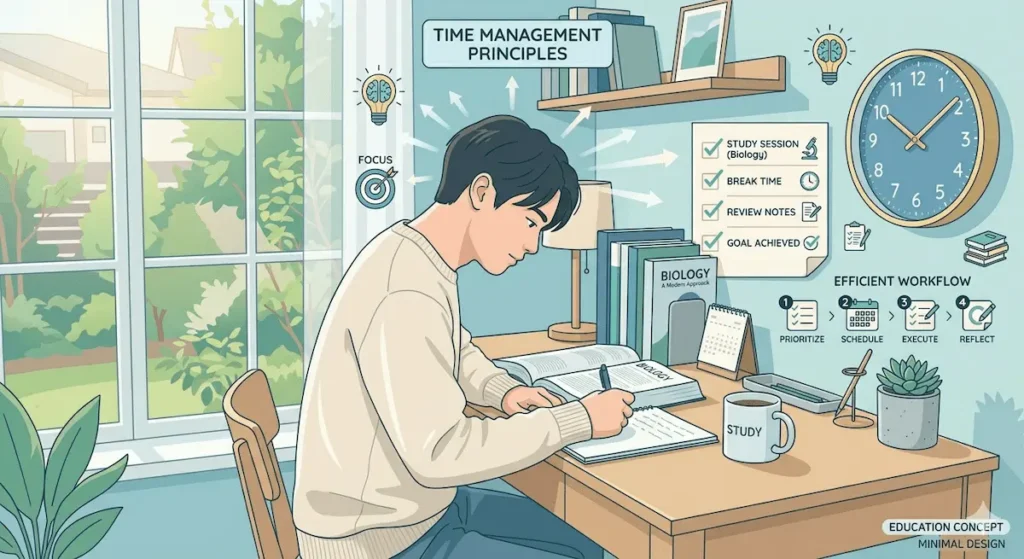
A proper daily routine for exams helps you:
- Stay focused every day using effective focus techniques
- Manage time effectively
- Reduce stress and anxiety
- Finish the syllabus faster
- Improve memory and revision
Without a routine, your studies become haphazard — and haphazard studying = poor results.
How to create the best daily routine for exams

1. Know your study time (morning or night)
Some students study better in the morning, others at night.
Choose the best time for your attention and create your daily routine for the exam accordingly.
2. Set clear goals for each day
Bad goal: – I will study math
Good goal: – I will finish chapter 2 and solve 20 problems
Clear goals = better performance.
3. Divide the subjects intelligently
Difficult subjects → morning
Easy subjects → evening
This increases efficiency and reduces excess workload.
4. Use study blocks (proven method)
Use this simple structure:
50 minutes of study
10 minute breaks
Or use Pomodoro:
25 minutes of study
5 minute breaks
5. Focus more on weak topics
Your daily routine for exams must include:
- Extra time for weak topics
- Practice difficult topics every day
Best daily routine for exam preparation (Sample)
Morning routine
5:30 AM – Wake up
6:00 AM – Exercise / Refresh your mind
6:30 AM – Read difficult topics
8:30 AM – Breakfast
- Morning = Peak attention time
Day routine
9:00 AM – Read new topics
11:00 AM – Short break
11:30 AM – Review
1:00 PM – Lunch + Rest
Evening routine
3:00 PM – Practice questions
5:00 PM – Break / Refresh
6:00 PM – Read weak topics
Night routine
8:00 PM – Light study / Review
Night 9:30 – Plan for the next day
10:30 PM – Sleep
Sleep is a part of your daily routine for exams
Some study techniques to improve your daily routine for exams
1. Active recall
Instead of studying:
- Questions to yourself about the topic you are studying
- Trying to remember without looking
2. Pomodoro Technique
Study in small focused sessions.
This keeps your brain active and reduces fatigue.
3. Feynman Technique
Explain things like you would teach a child.
If you can explain → you will understand.
4. Practice previous year questions
Very important for exams.
Solve Previous Year Question Papers Every Day
Daily Routine for Exams (Toppers’ Strategies)
Toppers follow these habits:
- Study early in the morning
- Take short breaks
- Revise daily
- Sleep for 7-8 hours
- Avoid distractions
Toppers don’t study too much — they study smartly.
Common Mistakes Students Make
Avoid these mistakes:
- Study without a plan
- Using an extra phone
- Not revising
- Studying for hours without breaks
- Ignoring weak topics
Pro Tips for Better Results
- Keep your study table clean
- Use a timer
- Drink water regularly
- Avoid social media while studying
- Track your daily progress
Simple Daily Routine Formula
- Study + Breaks + Revision + Sleep = Success
Frequently Asked Questions:
Question1: Which is the best daily routine for exams?
The best daily routine for exams includes:
- Study in the morning for difficult topics
- Take regular breaks
- Revise daily
- Sleep 7-8 hours
Question2: How many hours a day should I study for exams?
You should study for 6 to 8 hours a day, with proper concentration and breaks.
Question3: Is it better to study at night or in the morning?
Mornings are better for concentration, but if you are more productive then nights can also work.
Question4: How can I focus better while studying?
- Eliminate distractions
- Use the Pomodoro technique
- Study in a quiet place
Question5: Should I study every day before an exam?
Yes, studying every day is important to build consistency and avoid last-minute stress.
Conclusion:
A strong daily routine for exams doesn’t mean studying all day — it means studying smartly every day.
If you follow a proper routine:
- You will stay focused
- You will be able to finish the syllabus faster
- You will feel confident in the exam
Start today. Even a small routine can change your results.