

Introduction:
Brain exercises for students can greatly improve memory, attention, problem-solving skills, and learning speed. Just as regular exercise strengthens our muscles, the right habits can also make our brains more efficient.
Whether you are preparing for school exams, college exams, competitive exams, or just for everyday study—these simple brain training habits will help you focus, remember information for longer, and learn anything faster.
In this guide, we discuss some of the most effective brain exercises for students, proven by modern research, along with some practical tips. Students can start implementing these tips today.
Why brain exercises are important for students
Students often spend hours memorizing notes, paying attention in class, and preparing assignments. Despite all this, the following problems are seen in many:
- Quickly forgetting information
- Loss of attention
- Mental fatigue or brain fog
- Poor problem-solving skills
- Short-term attention loss
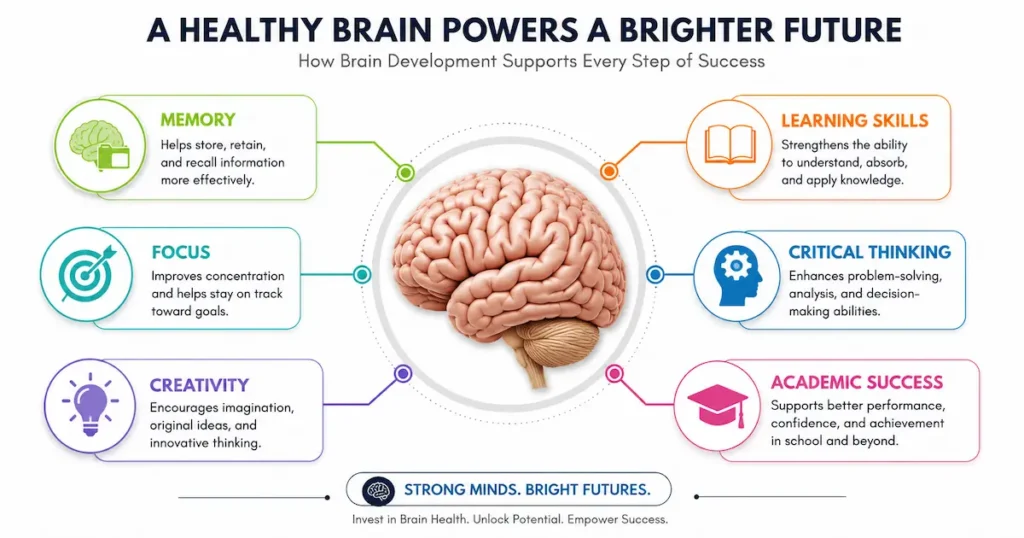
Recent neuroscience shows that our brain is always changing and adaptable due to a process called ‘neuroplasticity’. This simply means that your brain can create stronger connections when you regularly face new challenges.
This is exactly why brain exercises should be practiced for students, which improve the following areas:
- Memory
- Attention and concentration
- Learning skills
- Critical thinking
- Creativity
- Study results
In simple words, you can think of this brain training as a daily gym or workout for your mind.
How brain exercises improve learning
Before knowing the specific exercises, let’s understand the science behind them, that is, what exactly happens inside the brain.
When you actively solve a problem, learn a new skill, or challenge your memory, different parts of your brain start to communicate more effectively with each other. The benefits that result from this include:
- Faster information processing
- Improved working memory
- Improved attention control
- Better recall during exams
- Reduced mental fatigue
The best part is that most brain exercises only take a few minutes a day.
15 Best Brain Exercises for Students
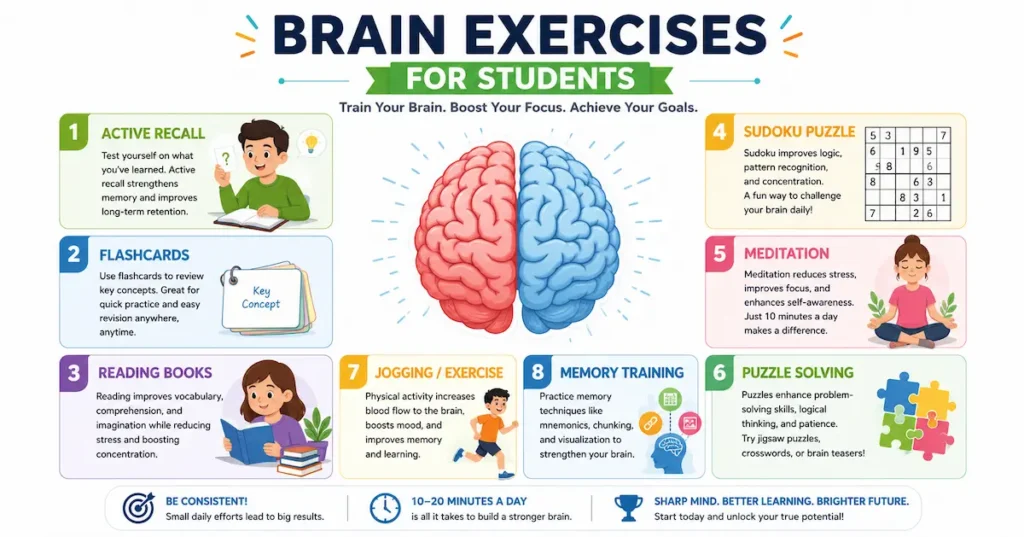
1. Practice Active Recall
Active Recall is one of the most powerful learning techniques. Instead of just revising your notes over and over again, close your book or notebook and try to remember what you’ve read on your own.
For example, after reading a chapter:
- Put the book aside
- Write down exactly what you remember in a notebook
- Check the mistakes against the original book
- Repeat the entire process again
This practice strengthens memory pathways and helps you remember what you read in the long term.
2. Solve puzzles regularly
The practice of solving puzzles also stimulates various cognitive functions of the brain. Some great options for practicing are:
- Sudoku
- Crossword puzzles (word puzzles)
- Logic puzzles
- Rubik’s Cube
- Brain teasers
These small games improve:
- Logical thinking
- Pattern recognition
- Problem solving skills
Even this practice of just 10 minutes a day can make a noticeable difference in your thinking.
3. Practice memory CARD games
Memory games increase our working memory and attention span. You can try these:
- Matching card games
- Flashcard recall exercises
- Sequence memory challenges
Preparing for exams, you can turn your study materials into memory games, which will not only make studying easier but also increase your attention.
4. Acquiring new skills
Learning something completely unfamiliar forces the brain to create new neural connections. For example:
- Photography
- Coding
- Drawing or sketching
- Public speaking
- Video editing
5. Reading beyond school textbooks
Most students limit themselves to only academic syllabus books. However, reading books from different genres can greatly strengthen their vocabulary, comprehension, and critical thinking.
You can read:
- Biographies
- Science articles
- History books
- Personal development books
The habit of reading diverse books introduces new ideas, which keeps your brain active.
6. Pomodoro Focus Exercise
Follow this excellent rule of study:
- Study with full attention for 25 minutes
- Take a short break of 5 minutes
After completing four consecutive sessions in this way:
- Take a long break
This technique eliminates mental fatigue and increases the ability to maintain continuous attention for a long time.
7. Meditation for students
Meditation teaches you to pull your mind from a distracted state and bring it back to the present moment. Its simple routine is:
- Sit comfortably.
- Close your eyes.
- Pay attention to your natural breathing.
- If any thoughts around or in your mind come to distract you, take it naturally.
- Return your attention to your breathing again.
8. Practice mindfulness observation
Choose any object near or in front of you. Take a full minute to observe the object very carefully:
- What is its color
- What is its shape
- How does it feel when you hold it (texture)
- Noticing the smallest details
Although it may seem very simple, this task sharpens your attention control and awareness.
9. Challenge yourself to avoid digital distractions
Set a timer on your watch for exactly 30 minutes. During this specific time:
- No touching your phone at all
- No accessing social media
- No opening any unnecessary tabs on your laptop or computer
This gives your brain a great workout to focus on one task without getting distracted.
10. Spaced Repetition
Instead of reading continuously, give yourself some time and breaks to revise what you have read.
An effective schedule:
- Day 1
- Day 3
- Day 7
- Day 14
- Day 30
Science says that this technique is great for transferring any information from our short-term memory to our long-term memory.
11. Teaching someone else
The best way to remember any complex information yourself is to explain it to someone else. Your teaching partner can be:
- Your brother or sister
- A close friend
- A classmate
When you try to explain something to someone, you realize where your understanding is lacking. As a result, your understanding becomes more perfect and stronger.
12. Connecting through stories
Tie the separate pieces of information together in a fictional or funny story.
For example,
If you have to remember several difficult points or ideas in a row in an exam, arrange them in a serial order to make a wonderful or strange story. Your brain can remember stories much more than dry information.
13. Visualization training
Converting the reading material into a visual or image in your mind instead of just memorizing it. Rather than memorizing simple text:
- Create a mental picture
- Imagine the whole scene
- Create a visual mental connection
This visualization or visualization will greatly activate your memory after sitting in the exam hall.
14. Dance-based learning
Learning any dance pose or step requires several things at the same time:
- Coordination
- Correct timing
- Memory to remember the steps
- Full attention
The simultaneous combination of all these things acts as an excellent cognitive exercise or metal exercise for your brain.
15. Aerobic exercise
Some simple physical activities such as:
- Regular walking
- Light jogging
- Cycling
- Swimming
These habits help increase your cognitive performance and mental clarity. Even some light exercise of just 20 minutes before sitting at the study table can greatly increase your interest and readiness to learn.
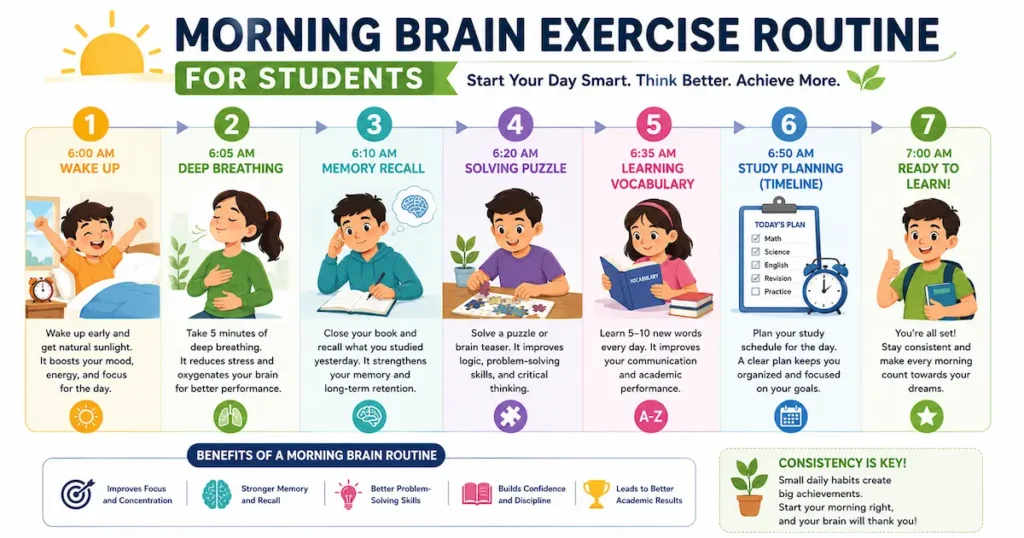
Morning Brain Exercise Routine for Students
You can start your day with this simple routine that takes just 15 minutes after waking up in the morning:
- Minutes 1–3: Close your eyes and take deep breaths.
- Minutes 4–6: Try to remember the previous day’s reading.
- Minutes 7–10: Solve a Sudoku, puzzle, or brain teaser.
- Minutes 11–13: Learn two new words or vocabulary.
- Minutes 14–15: Plan your study goals or to-do list for the day.
This little routine will make your sluggish brain very alert and active before starting any class or study.
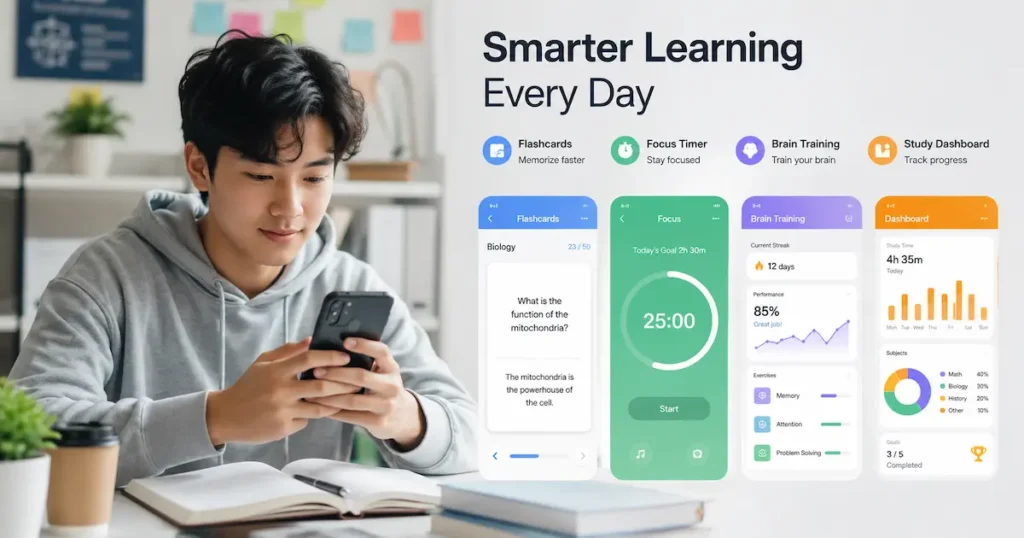
Modern brain training tools that students can use
Smartphones or technology, if used correctly, can be a great help in your intellectual development. Here are some useful tools for students:
- Flashcard apps: Anki, Quizlet
- Brain training apps: Lumosity, Elevate, Peak
- Focus apps: Forest, Focus To-Do
These modern apps will make your traditional study method easier and more dynamic.
Common mistakes that students make while training their brain
To get the desired results, eliminate these mistakes from your daily studies today:
- Passively studying: If you just read the readings without checking or testing yourself, your ability to remember decreases day by day.
- Multitasking: If you suddenly switch from one task to another, your brain’s ability to focus weakens.
- Lack of sleep: There is no substitute for adequate sleep to permanently retain the day’s reading in your head.
- Avoiding physical activity: A sedentary lifestyle damages the brain; exercise keeps the brain healthy and its ability to learn active.
- Irregularity: Like any habit, brain training does not yield any benefits if you do not maintain the right rules and consistency.
Brain exercises for students during exam preparation
The pressure to remember reading is very high on exam days. So, pay a little extra attention to the following things at this time:
- Trying to actively remember what you read
- Revising at regular intervals
- Taking mock tests or practice exams
- Using various mnemonics or memory techniques
- Taking small meditation sessions between studies
If you apply these proven methods, every minute invested in your exam will bring maximum results.

Creating a Daily Brain Training Habit
Here is a simple and effective daily action plan for your convenience:
| Activity | Time |
| Meditation | 5 Minutes |
| Puzzles or Brain Games | 10 Minutes |
| Active Recall Practice | 15 Minutes |
| Reading Non-fiction or Educational Books | 20 Minutes |
| Physical Exercise or Workout | 20 Minutes |
Total time: Only 70 minutes per day.
Remember, it’s more about consistency, taking small steps each day, than doing something too difficult at the beginning.
Frequently Asked Questions (FAQ)
Question: What are the best brain exercises for students?
Active recall, solving puzzles, regular meditation, playing memory games, revising at regular intervals, and learning new skills are the most effective brain exercises for students.
Question: How often should students do brain exercises?
Students can get great results if they set aside 15 to 30 minutes every day for this brain-training. It is important to maintain consistency for a short period of time every day rather than spending a lot of time once a week.
Question: Do brain exercises improve test scores?
Yes, of course. Doing these exercises regularly greatly improves your memory, ability to focus, and any problem-solving skills. And this has a direct positive impact on academic results.
Question: Which brain exercise increases attention the most?
Meditation, mindfulness practice, and the habit of reading for extended periods of time—following the Pomodoro technique—are the best ways to quickly raise the attention graph.
Question: Can physical exercise improve brain function?
Yes, absolutely. Regular physical activity increases blood and oxygen flow to the brain, which indirectly boosts memory, attention, and overall intelligence.
Question: Are brain-training apps beneficial for students?
If you use them in addition to your core studies, book reading habits, and real-life learning, brain-training apps like Anki, Elevate, or Lumosity can definitely help.
Conclusion:
You don’t have to follow any complicated rules to build a sharp and powerful brain. Small, simple daily habits like active recall, regular meditation, solving fun puzzles, physical exercise, and attentive reading will greatly increase your memory, focus, and learning speed over time.
In fact, brain exercises for students work best when they are practiced systematically. So start with any one or two habits today, make them a part of your lifestyle, and gradually create your own personal brain-training routine.
Share your experience:
Which brain exercise for students on this list has helped you the most? Share your wonderful experience with us by commenting below. Your comment can help other students find a new way to improve their focus, memory, and achieve the desired success in their studies!