

Introduction:
Many students shy away from studying difficult subjects at first, thinking that they are impossible. However, the real truth and the good news is that if you follow a proper and scientific process in your studies, instead of relying entirely on temporary motivation, even difficult subjects become much easier.
The strategies discussed below are very realistic, scientifically researched, and very useful for improving the quality of studies for students of all types and ages. In today’s detailed guide, you will know how to actually study difficult subjects and how to overcome the fear of studying and achieve the desired results in the exam.
1. Accept that the subject seems difficult
The first step in mastering any complex subject is to change your inner mindset. Many students are often heard saying:
- I have always been very raw in math.
- Physics does not enter my head.
- It is impossible for me to remember chemical reactions.
Instead of these negative words, you should change your thoughts a little positively and think like this:
- I have not fully understood the subject yet, but if I try, I will definitely be able to.
Fostering such a growth mindset in your mind greatly encourages your inner perseverance and accelerates the long-term learning process.

2. Dividing big things into small learning goals
When you sit at a table and look at a whole thick textbook or a big syllabus at once, a kind of intense anxiety and fear arises in your mind. To avoid this unnecessary fear, divide each big chapter or section into small and easy parts.
For example, instead of the wrong decision of reading the whole chapter at once:
- Today I will memorize Chapter 5 completely.
Create such simple and small goals for yourself:
- First learn the important definitions of the chapter well.
- First understand the main idea or topic that is there deeply.
- I will solve at least 5 mathematical questions from this chapter.
- Find and review your mistakes in the solution.
- Finally, test yourself and verify.
Achieving small goals in reading gradually increases your confidence.

3. Previewing the topic before reading
Never start reading any chapter and immediately start reading the main lines in detail. Before starting reading, spend just 5 to 10 minutes to quickly glance at the entire topic.
What you will notice during this time:
- What are the main headings and subheadings of the chapter.
- The various images, diagrams or graphs contained within.
- The summaries given at the very end of the chapter.
- The important formulas or terms highlighted on the page.
- The main learning objectives of the chapter given at the beginning.
By taking a little look at it before starting to read deeply, your brain subconsciously creates a beautiful mental structure of the chapter.
4. Focusing on understanding before memorizing
Many students start memorizing just to write in the exam notebook without understanding the definition of any difficult topic. But this wrong method of memorizing like a blind person without understanding almost never works in the following subjects:
- Mathematics
- Physics
- Chemistry
- Biology
- Economics
- Programming or coding
So while studying, always develop the habit of asking yourself some analytical questions, such as:
- Why exactly does this formula or rule happen?
- How does this process actually work?
- What is the main reason for this particular result?
- Where exactly is this mathematical concept used in real life?
Understanding any subject well in your mind makes your memory power much stronger and that reading is not easily lost from your mind.
5. Studying difficult subjects during your peak energy
You always need your freshest, calmest and most alert brain to untangle the most complex and difficult subjects in your syllabus. According to science and psychology, most students are best able to concentrate during the following times of the day:
- After waking up early in the morning
- Right after finishing a nutritious breakfast
- After a short light exercise or walk in the afternoon or evening
So it is wise to avoid deciding to study difficult subjects at the following times:
- Late at night when your body and mind are asleep
- When you are extremely tired after a day of work or classes
- Right after a heavy meal at lunch or dinner
Always save your best mental energy and focus time of the day for difficult studies.
6. Use active recall instead of passive reading
One of the most scientific and powerful study techniques in the world of study is active recall. Instead of opening a book and passively reading the same reading over and over again:
- Close the book or notebook completely in the middle of reading.
- Try to remember the answers to the questions you read from memory.
- Explain the whole concept out loud to yourself on the wall or in the sky.
- Try to solve complex problems yourself without looking at the book.
These great exercises activate the neurons in your brain and strengthen your memory much faster.

7. Practice difficult problems every day
Complex and difficult topics only become easier through regular hands-on practice—not just through reading. Especially for subjects for which regular practice is mandatory:
- Mathematics or Higher Math
- Mathematical problems and reactions of chemistry
- Various complex formulas and numbers of physics
- Various charts and calculations of statistics
- All complex math of accounting
Always try to follow the following sequential method when studying these subjects:
- Understand the basic theory ➔ Pay attention to the examples in the book ➔ First solve easy questions ➔ Then take medium-quality questions ➔ Finally solve the difficult questions yourself.
In studies, it is much more important to maintain this consistency of reading regularly for 2 hours every day than to study continuously for 10 hours a day.
8. Teaching the subject to someone else
The Feynman Technique of world-famous scientist Richard Feynman is a very excellent way to overcome the fear of difficult subjects. Imagine that you are teaching someone the difficult subject you have just read in very simple terms:
- A younger sibling at home
- A friend in your class
- Your simple-minded parents
- Standing in front of the mirror at home
If you cannot explain the subject you have read to someone else in very simple terms without using any complex words, then you have to understand that you yourself have not yet understood the subject deeply enough.
9. Using the visual learning method
Our brain is structured in such a way that any difficult or complex concept becomes much easier when you can visualize it in front of your eyes. You can use the following excellent tools to remember reading easily:
- Mind maps
- Flowcharts
- Concept maps
- Various colorful diagrams
- Timelines of historical events
- Colorful notes and highlighter pens in the reading notebook
This visual learning reduces the fear and stress in the mind and helps a lot in connecting one concept to another easily.

10. Study in small, focused sessions
Your brain has a limited ability to pay attention. So instead of sitting at your desk for three to four hours without a break, use the Pomodoro technique.
A simple example of this method is:
- First, study for 25 minutes without any devices and focus completely.
- Then, take a refreshing break of just 5 minutes by keeping a watch.
- Complete four consecutive sessions (25 minutes of study + 5 minutes of break).
- After completing the 4 sessions, take a long break of 20 to 30 minutes.
This very popular technique increases brain performance and attention by eliminating the fatigue or monotony of studying.
11. Reviewing mistakes more than correct answers
Most students are overjoyed when they get a correct answer on a test or practice and stop studying there. However, real improvement in studying comes from analyzing their mistakes in detail.
So after each practice session, ask yourself these exact questions:
- Why exactly was this particular answer wrong?
- What key idea or formula did I misunderstand here?
- How can I avoid making the same mistake next time?
Keep a dedicated mistake notebook on your study table for this. Take time out at least once a week to review your mistakes repeatedly.
12. Use spaced repetition
Reading a difficult passage just once is not enough to do well on a test. To remember what you read for a long time, review the information in stages, following the scientific spaced repetition method:
- Day 1 (first day of reading)
- Day 3 (first revision on the third day)
- Day 7 (second revision after a week)
- Day 14 (third revision after two weeks)
- Day 30 (fourth revision after a month)
This effective method will dramatically improve your mind’s long-term memory.
13. Connecting new information to real life
When any abstract or difficult scientific concept is connected to familiar events in your daily life, it sets in your mind very quickly.
Some great real-life examples are:
- Physics ➔ Thinking about how the wheel stops when you press the brake of a bicycle.
- Chemistry ➔ Observing the reaction of salt or spices in a curry in the kitchen.
- Biology ➔ Observing the contraction of the body’s muscles during exercise.
- Economics ➔ Calculating the amount of money you spend on groceries at the market.
- History ➔ Understanding the context of a recent event that happened around you.
These real-world visual examples make the memory pathways in the brain much stronger.
14. Completely eliminate distractions
Trying to do more than one thing at the same time or multitasking at the study table completely reduces the overall effectiveness of learning.
So, just before sitting down at your main study table every day:
- Put your phone on silent or turn it off and keep it away.
- Close all unnecessary browser tabs on your laptop or computer.
- Turn off all types of social media notifications.
- Keep only the reading materials you need at that time on your study desk.
This quiet environment free of distractions around you helps your brain to focus deeply on a specific topic.

15. Ask questions without being embarrassed
It is very normal to have confusion in your mind when studying any new or difficult subject. So if you don’t understand something, don’t be shy and ask questions directly:
- Your school or college teachers
- Your personal tutors or tutors
- Your classmates or close friends
- In various educational online study communities
Remember, a single right question asked at the right time can easily save you from hours of unnecessary frustration and wasted time.
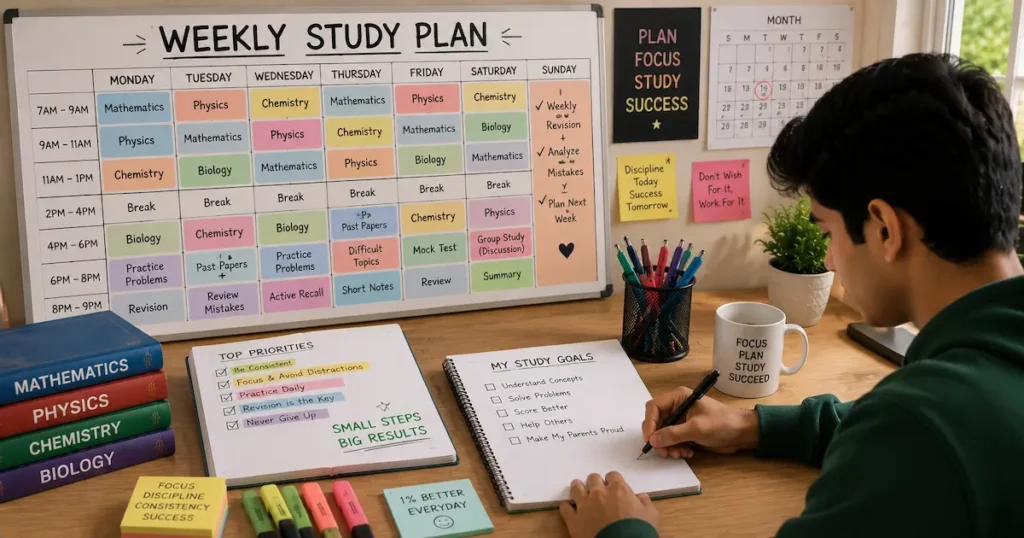
16. Create a weekly study routine
Just suddenly sitting down to study a difficult subject once a week is not enough to learn. Below is a sample of a scientific weekly plan:
| Day | Activity |
| Monday | Learn an entirely new concept or formula |
| Tuesday | Practice various questions and mathematical problems on that topic |
| Wednesday | Deeply review the notes you created previously |
| Thursday | Try to solve relatively difficult and advanced problems on your own |
| Friday | Take a self-assessment or a mock test |
| Saturday | Identify and analyze the mistakes made in the test |
| Sunday | Do a quick weekly revision of all the topics studied throughout the week |
Maintaining this daily consistency yields much more effective results than temporary intensification in studying.
17. Taking care of your brain
If your body is completely healthy and alert, then your brain will be able to easily absorb any difficult reading.
So, add these to your lifestyle on a daily basis as a priority:
- At least 7 to 9 hours of deep sleep every day
- A little physical movement or light exercise daily
- Eating nutritious and healthy food
- Drinking enough water to keep the body hydrated
- Small relaxing mental breaks between readings
Among these, sleep is especially important, because when you get enough rest at night, your brain permanently consolidates or saves the new memories learned throughout the day in the mind.
Common mistakes made by students
To maintain the quality of study, students must avoid these harmful daily habits:
- Trying to read everything at once in a hurry the night before the exam.
- Memorizing a subject blindly without understanding the main theme of it.
- Skipping past year or chapter practice questions without solving them.
- It is useless to compare yourself with others about your study speed.
- Giving up after reading a difficult or complex chapter once without understanding it.
- Reading with other thoughts in mind or with music playing in the background.
- Always ignoring or avoiding the weak points of your preparation.
If you can correct these small mistakes in your daily reading habits, it is possible to make a lot of progress in your studies.
The best tools for studying difficult subjects
The following best digital tools and materials will help you make your studies much easier and more effective:
- Anki (flashcards): For easy revision of reading.
- Quizlet: For quizzes and self-tests on various subjects.
- Khan Academy: For easy understanding of complex subjects through videos.
- YouTube’s educational channels: For excellent visual explanations of difficult topics.
- Notion: To organize all your class notes and study plans in one place.
- Google Calendar: To determine a study schedule or study block.
- Forest App: A game that helps you stay away from your phone while studying.
- Microsoft OneNote: For use as a digital notebook.
Always choose useful materials that directly support your own learning style and do not distract you from your studies.
Sample Daily Study Plan
| Time | Activity |
| 07:00 AM – 07:45 AM | Study the most difficult subject in the first session of the day |
| 07:45 AM – 08:00 AM | Take a short break to refresh both body and mind |
| 08:00 AM – 08:45 AM | Solve mathematical or practice problems of the difficult subject |
| Afternoon | Study relatively easier or preferred subjects |
| Evening | Briefly review the difficult concepts studied in the morning |
| Before Bed | Practice active recall for at least 10 minutes on the topics studied throughout the day |
Frequently Asked Questions (FAQs)
Question: Why do some subjects seem harder than others?
Because they often contain completely new and unfamiliar concepts that require deep thinking to understand. Advanced subjects may seem much more difficult later on, mainly because the basics are weak in the previous class.
Question: How many hours should one study a difficult subject per day?
For most students, an average of at least 1-2 hours of intensive study per day is enough. The key here is to maintain the depth and quality of reading rather than the total number of hours spent sitting at the desk.
Question: Is it better to memorize or understand first?
Always try to understand the main idea of the chapter well in your mind first. Because once the subject is clear in your mind, it becomes much easier to memorize and lasts longer.
Question: What should I do if I keep forgetting what I read?
Instead of just reading or taking notes over and over again, use scientific strategies for memorizing, such as active recall, spaced repetition, and regular practice.
Question: Can I study two difficult subjects in a day?
Yes, you can. However, to reduce mental fatigue or boredom, be sure to take adequate short breaks between reading sessions and alternate between different types of thinking; for example, after practicing math, you can spend some time on factual topics like history.
Question: How do I stay motivated when a subject seems impossible?
Instead of thinking about being perfect or topper in one leap, focus on small daily targets or progress. Completing just one difficult concept each day will build your confidence and motivate you to move forward.
Conclusion:
In reality, learning how to study difficult subjects depends much more on using some effective and scientific strategies consistently than on human innate intelligence.
Breaking down any complex subject into smaller, simpler parts, practicing active recall regularly, reviewing your mistakes over and over again, and following a specific reading routine can turn even the most difficult subject into an easy challenge.
Remember, every great expert in today’s world struggled with some fundamental subject at the beginning of their careers. So be patient with yourself, keep practicing regularly, and celebrate the small improvements you make each day—these small changes over time will one day bring you huge success in your life.
Share your experience
Which subject do you find the most difficult in your academic life—math, physics, chemistry, biology, or any other subject?
If you have any of your own magical tricks or reading problems, share them with us in the comments box below. Your valuable experience may show another student a new way to overcome their fear of reading and learn more effectively!