
Introduction:
A 30-day study plan before an exam can completely transform your results if followed correctly. Many students get panicked when the exam is just a month away. They feel stressed, confused and disoriented when they see the syllabus.
But the truth is very simple:
If you study intelligently instead of haphazardly, thirty days is enough to prepare effectively.
A proper 30-day study plan before an exam helps you:
- Master important topics
- Improve weak topics
- Revise regularly
- Reduce exam stress
- Boost self-confidence
- Do better in exams
This guide will show you a complete step-by-step method that students can follow realistically without tiring.
Why a 30-day study plan before an exam is effective

Most students waste time studying without making a specific plan.
A well-organized 30-day study plan before the exam is effective because it provides:
- Clear daily goals
- Proper revision cycle
- Organized topic management
- Continuous practice
- Enough time for mock tests
Instead of studying in a panic, you follow a method.
Which in turn creates your progress.
How to start your 30-day study plan before the exam

Before starting your studies, you first need to organize your preparation.
Step 1: Analyze your syllabus
Take all the subjects and divide the chapters into:
- Easy
- Medium
- Difficult
Now identify:
- High-marking chapters
- Repeatedly repeated topics
- Formula-based chapters
- Theory-based topics
This will give you a clear idea.
Step 2: Prioritize important topics
Don’t spend equal time on everything.
Focus more on:
- Higher-marking chapters
- Weak topics
- Important formulas
- Repeated questions in the exam
Read intelligently, not blindly.
Step 3: Make a realistic schedule
A realistic schedule is essential in the 30-day study plan before the exam. Avoid impossible schedules like:
- 14 hours a day
- No breaks
- No sleep at all
Instead, focus on consistency.
Set a realistic goal:
- Study for 4 to 8 hours every day
- Sleep for 7-8 hours
- Revise regularly
- Practice questions every day
Complete a 30-day study plan before the exam
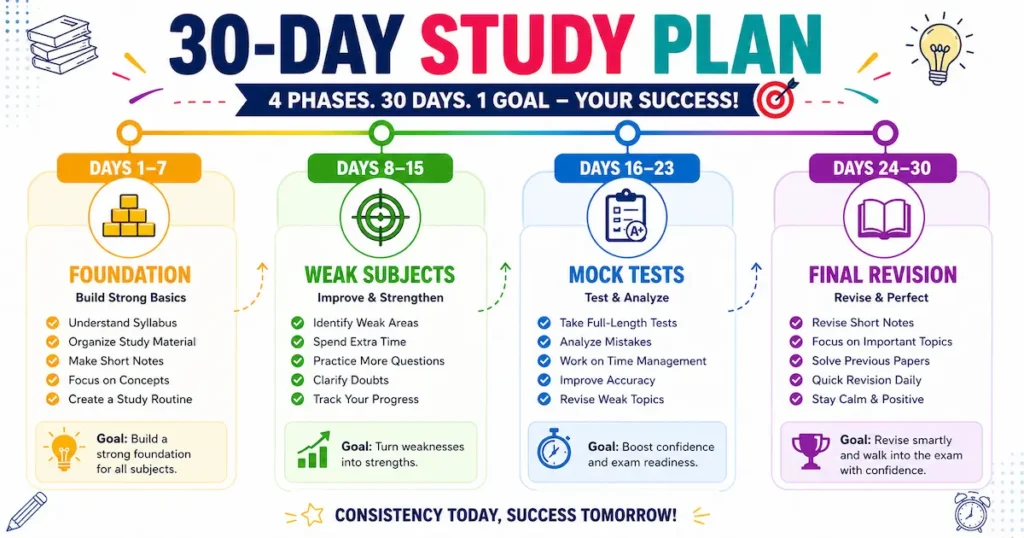
Days 1–7: Foundation Phase
The first week should focus on understanding key concepts and completing important chapters.
First week goals
- Understanding key concepts
- Completing high-priority chapters
- Building a study pace
- Making short notes
Daily Routine
| Time | Task |
| Morning | Study difficult subject |
| Afternoon | Practice questions |
| Evening | Revise old topics |
| Night | Quick formula revision |
H3: Best study strategies for the first week
Active recall
Instead of rereading, test yourself.
Example:
After reading a chapter, close the book and write down what you remember.
This improves memory quickly.
Spacing review
Revisiting topics repeatedly at intervals.
Example:
- Day 1 → Learn
- Day 3 → Review what you have read
- Day 7 → Review again
This helps prevent forgetting.
Days 8–15: Improving Weak Points
This is the most important stage of the 30-day study plan before the exam.
Now you need to focus on your weak points.
What to do at this stage
- Solve difficult questions
- Practice number problems
- Improve answer writing
- Learn formulas daily
- Remove conceptual confusion
How to improve weak subjects
For Maths
- Practice daily
- Solve step by step
- Repeat difficult numbers
For Science
- First understand concepts
- Then memorize formulas
- Practice diagrams and definitions
For English
- Practice grammar
- Improve writing structure
- Learn vocabulary
Days 16–23: Revision and mock test phase
Now your preparation will turn towards the exam results.
Start solving mock tests
A smart 30-day study plan before the exam always includes mock tests.
Mock tests mainly help students to:
- Increase speed
- Reduce test anxiety
- Identify mistakes in time management
How many mock tests should you take?
Recommendations:
- 1 mock test every 2 days
- Chapter-wise tests every day
- Regular past year question papers
Analyze your mistakes
After each mock test, check:
- Accidental mistakes
- Weak concepts
- Time management issues
Analysis of mistakes is more important than the score.
Days 24–30: Final revision phase
The last week should be focused on calm and intelligent revision. Don’t:
- Starting too many new chapters
- Study all night
- Panic
Instead:
- Revise summaries
- Review formulas
- Solve important questions
- Stay mentally calm
Best Daily Routine During Final Week
| Time | Activity |
| Morning | Revise difficult topics |
| Afternoon | Practice one paper |
| Evening | Review mistakes |
| Night | Light revision |
Best Study Methods for Exam Preparation
Pomodoro Technique
Study:
- 45 minutes of focus
- 10 minute breaks
It increases focus.
Using the Feynman Technique
Explain the subject you are studying in simple terms.
If you can’t explain it simply, you don’t understand it fully.
Practice past year questions
As past questions reveal:
- Important patterns
- Repeated concepts
- Level of difficulty of the exam
This is one of the fastest ways to increase your score.
How to stay focused during exam preparation
It is common to have trouble focusing during the 30-day study plan before an exam.
Eliminate and
Avoid major distractions:
- Excessive social media use
- Gaming while studying
- Multitasking
- Unnecessary phone use
Create a suitable environment for studying
Your study space should be:
- Clean
- Quiet
- Tidy
- Free from distractions
A suitable environment enhances performance.
Ways to reduce exam stress
Stress management is very important.
Effective ways to reduce stress
Get enough sleep
Sleep helps improve memory. Aim for:
7 to 8 hours every day Sleeping
Do light exercise
A simple walk increases focus and reduces anxiety.
Avoid comparing yourself with others
Every student learns differently. Focus on your own improvement.
Food and Nutrition During Exam Preparation
Best Foods for Students
- Eggs
- Almonds
- Bananas
- Fish
- Vegetables
- Fruits
- Water
Avoid:
- Excessive Junk Food
- Excessive Caffeine
- Energy Drinks
Common Mistakes Students Must Avoid
1. Studying Without a Plan
Studying haphazardly is a waste of time.
2. Ignoring Weak Topics
Weak chapters should be given more attention.
3. Staying Up All Night
Lack of sleep reduces concentration.
4. Passive Study
Studying without testing yourself is ineffective.
5. Skipping Revision
Real learning is achieved through revision.
Benefits of following a 30-day study plan before an exam
A proper 30-day study plan before an exam helps students:
- Study consistently
- Improve memory
- Reduce stress
- Manage time better
- Revise effectively
- Increase self-confidence
- Get higher marks
Smart preparation is always better than last-minute rush studying.
Sample One-Day Exam Study Timetable
| Time | Task |
| 6:00 AM | Wake up |
| 6:30–8:00 AM | Difficult subject |
| 8:00–9:00 AM | Breakfast + break |
| 9:00–11:00 AM | Practice questions |
| 11:00–12:00 PM | Revision |
| 2:00–4:00 PM | Second subject |
| 5:00–6:00 PM | Mock test |
| 8:00–9:00 PM | Formula review |
Final Tips for Success
The best students are not always the most talented.
They are usually the most consistent.
A successful 30-day study plan before an exam depends on:
- Discipline
- Review
- Practice
- Focus
- Thoughtful Planning
Don’t wait for motivation.
Start today. Even small daily steps can create big results after 30 days.
Frequently Asked Questions (FAQ)
Question 1: How many hours should I study daily before an exam?
Most students do well if they study 4 to 6 hours a day with proper revision and practice.
Question 2: Is 30 days enough to prepare for an exam?
Yes. A proper 30-day study plan before an exam is enough, if you study consistently and focus on important topics.
Question 3: What is the best study method before an exam?
Active recall, spaced repetition and mock tests are among the most effective study methods.
Question 4: Should I study new topics in the last week?
Avoid starting too many new topics in the last week. Focus mainly on revision and practice.
Question 5: How can I avoid exam stress?
Get enough sleep, take short breaks, do light exercise and follow a well-organized study routine.
Question 6: Are mock tests important before an exam?
Yes. Mock tests improve speed, confidence, accuracy, and time management skills.
Conclusion
A well-organized 30-day study plan before the exam can completely change the way you prepare for the exam. Even though your exam is very close, you still have enough time to improve your understanding, strengthen weak points, revise important chapters and build confidence.
The key is not to study for hours. The real secret is the right strategy, proper revision, regular practice and consistent effort every day.
Remember:
- Studying smart is more effective than hard work.
- Revision is more important than re-studying.
- Mock tests help improve the results of the real exam.
- Consistency is more important than motivation.
Don’t panic about the syllabus that you haven’t finished yet. Focus on what you can do today and keep improving step by step every day.