

Introduction:
Self-study is one of the most valuable and powerful skills in a student’s educational career. Whether you are preparing for annual school exams, tough college courses, various competitive exams or learning a new skill in your personal life, knowing how to self-study effectively and using the right methods will go a long way in saving you valuable time, increasing your memory power and understanding any complex subject in depth.
In this detailed guide, you will find some of the best science-backed study techniques, realistic effective self-study methods, common mistakes to avoid and a step-by-step actionable plan, which will make your entire process of independent learning much easier, more enjoyable and more productive.
What is self-study?
Self-study is a continuous process of learning on your own without relying entirely on teachers, coaching or a traditional classroom.
Many students think that self-study may only mean hours of reading textbooks. In reality, effective self-study is much more comprehensive and effective than just reading books.
Its key components include:
- Setting clear and specific learning goals
- Creating a balanced study schedule or routine according to your convenient time
- Practice what you are learning every day
- Testing yourself through tests or quizzes at regular intervals
- Reviewing difficult and complex topics repeatedly over time
- Improving your weak areas quickly based on the results obtained
This excellent method of studying not only increases your academic knowledge, but also helps in building mental independence, strong self-discipline and long-term confidence within you.

Why self-study is more important now than ever
In the past few years, the entire education system worldwide has undergone an unprecedented and significant change. Nowadays, students are easily getting an excellent opportunity to use various quality online courses, educational videos on YouTube, vast digital libraries, modern AI-powered learning tools and thousands of free resources or information across the internet.
So now, just attending classes regularly every day is not enough for good results. Visionary students who can effectively master the ways and techniques of self-study are always a few steps ahead of ordinary students.
Students who are accustomed to this strategy usually:
- Can learn any new subject much faster than others.
- Acquire very strong problem-solving skills in real life.
- Perform very well in institutional or any competitive exams.
- Become a lifelong and relentless learner in every aspect of life.
- With the passage of time, they can easily adapt to any new subject and challenging profession.
Whether you’re studying math, physics, chemistry, a new language, coding or programming, or history, knowing how to self-study effectively will help you take full control of your entire learning journey.

Benefits of Self-Study
There are many diverse benefits of studying independently, which are not limited to getting good grades or marks in exams.
Learn at your own pace
Every person in the world has a completely different learning style and ability. Some students may understand a difficult topic very easily in just 10 minutes, while another student may take up to 1 hour to understand the same topic. Self-study gives you the wonderful freedom to slow down and understand difficult concepts at your own pace and move quickly on topics that you already understand well.
Improves critical thinking
Instead of the old method of blindly memorizing information, self-study constantly encourages you to ask new questions on each topic, compare multiple ideas, solve real problems, and independently find the right answer.
Builds self-discipline
One of the greatest benefits of self-study is that it builds strong self-discipline. Since you don’t have anyone to remind or supervise you to sit down at your desk every day to study, you learn to manage your time properly and stay focused on your goals.
Boosts confidence
When you can understand any complex and difficult subject on your own without the help of anyone else, it boosts your confidence in your mind.
Makes learning more effective
Genius students who follow the self-study method effectively do not waste time reading the same notes over and over again.
Instead, they use the following popular and proven techniques:
- Active memory techniques
- Spaced repetition
- Regular practice tests or mock tests
- Mind mapping and visual note-taking
- Teaching what you have learned to someone else in simple language
These modern methods of studying not only prevent wasting time but also greatly enhance your understanding of any subject.

Why do many students struggle with self-study?
When self-study seems too difficult for some, many students mistakenly believe that they may lack talent or intelligence. But in most cases, the real problem is not a lack of talent—but rather the application of incorrect and ineffective study strategies or habits.
The main reasons why students generally struggle with self-study are briefly discussed below:
Lack of a clear study plan
When you sit at your desk every day and suddenly open a book without specifying exactly what to read or how much to finish, your attention is often disrupted and valuable time is wasted.
Passive reading
While reading the same page or paragraph of a book repeatedly and idly, you may develop a temporary familiarity with the subject, but you do not develop a real understanding or permanent concept of that information in your brain.
Excessive distractions
The constant notifications of the phone around the study room, social media apps, television playing in the background and frequent fumbling with the mobile phone completely distract your attention.
Unrealistic expectations
Many students have unrealistic expectations of mastering a huge chapter or book in one sitting on the first day of studying. However, the brain needs sufficient time to learn any new reading properly.
Fear of difficult topics
Most students avoid difficult topics in the syllabus in the beginning, because the topics seem very confusing at first sight. But the irony is that the more you avoid difficult topics, the more frightening and difficult they become for you later. Breaking any big and complex topic into small parts makes learning much easier.

The best way to self-study effectively
The difference between an average student and the top achiever in the class is never due to intelligence or talent. In most cases, the main reason for this difference is the quality of their study strategies and daily study habits. Below are some widely tested and proven effective self-study methods that will bring a radical change in your entire study experience.
Set a clear learning goal before each study session
Never sit down at your study table without knowing exactly how much you want to learn or what you want to achieve.
For example, instead of vaguely saying I will study biology today, set a specific goal like the following:
- Today I will understand the stages of photosynthesis better.
- I will solve 10 specific math problems from algebra exercises.
- I will learn 20 new important vocabulary words from an English book.
- I will finish reading the third chapter of history and write a brief summary of it.
Setting such a clear and specific goal in studying increases the focus of the brain many times over.

Creating a Daily Self-Study Routine That Really Works
Knowing how to self-study effectively is just the first step. The next real challenge is to turn those scientific techniques into a concrete daily habit that you can easily follow every day.
Step 1: Set your study goals
Start each study session with a clear and specific objective.
Instead of saying, I will study biology today. Say:
I will better understand the process of photosynthesis today and solve 15 related practice questions on my own.
Such a specific goal makes the entire study process much easier and more organized.
Step 2: Prepare everything before you start
Avoid wasting the first 15 minutes of your session searching for the necessary books or notes while studying.
Before sitting down to study, prepare the following on your desk:
- Required textbooks
- Notebook or draft pad
- A bottle of drinking water
- Calculator (as needed)
- Required pens and highlighters
- Laptop or other devices
- Practice questions and test papers
A well-organized and prepared desk before studying greatly reduces the risk of distractions.
Step 3: Study in blocks of attention
Instead of reading for three hours straight at your desk without a break, divide your work into small blocks of time.
A great example is:
- 45 minutes of intensive study
- 10 minutes of light and refreshing breaks
- Repeat the cycle in this way.
This strategy keeps your brain fresh and alert for a long time.
Step 4: Review before finishing
Do not close your book and get up from your desk as soon as the allotted time for reading is over. In the very last 10 minutes of the session, ask yourself these exact questions:
- What exactly did I learn in this session today?
- What key points or concepts do I still not fully understand?
- What exactly do I need to review or revise for tomorrow at the beginning?
This simple practice with yourself works wonders to improve your long-term memory many times over.

Best Study Strategies for Independent Learners
Different types of subjects in the syllabus always require different learning methods. Below are some of the most effective and proven strategies for independent learners:
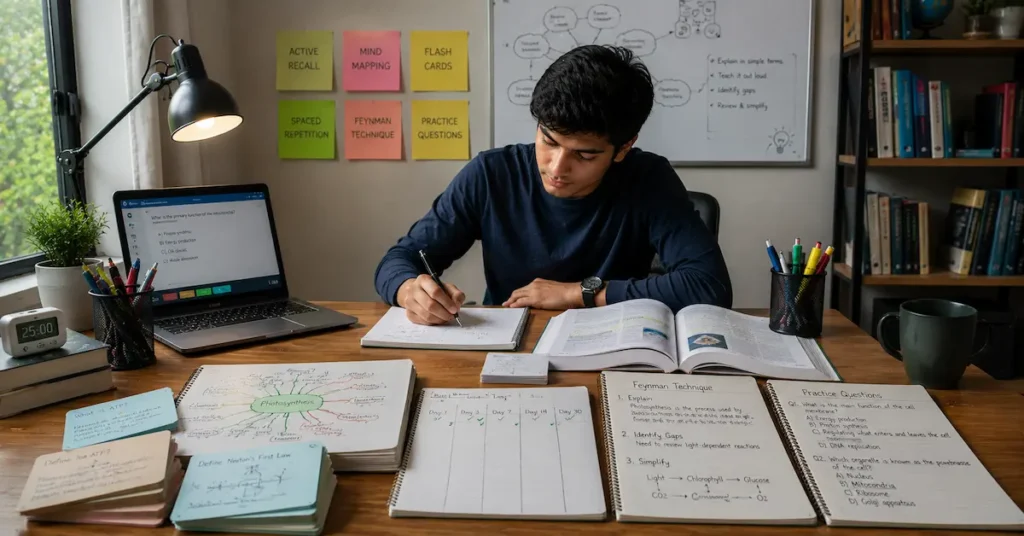
Active Recall
Instead of passively rereading the same book or notes over and over again:
- Close your reading book or notes completely.
- Try to recall or verbalize the answers to the questions you have read from memory to yourself.
This great practice forces your brain to retrieve information from deep within your mind, which helps in making learning permanent.
Spaced Repetition
To prevent forgetting, revise or review different topics several times over a period of days.
A typical sample schedule:
- Day 1 (First Reading)
- Day 3 (First Revision)
- Day 7 (Second Revision)
- Day 14 (Third Revision)
- Day 30 (Fourth Revision)
Adhering to this spaced repetition in studying dramatically reduces the tendency to forget.
Feynman Technique
To check how much you have understood the material, pretend in your mind that you are teaching the subject to a complete beginner. If you cannot explain a complex subject to someone in very simple language using simple words, then you have to understand that you have not yet fully mastered the main mystery of the subject.
Mind Mapping
Creating mind maps to visually connect different complex concepts or topics.
Mind maps are especially helpful in subjects where:
- Biology
- History
- Literature
- Geography
Practice Tests
Don’t just read the readings while studying. Regularly solve on your own:
- Previous year question papers
- Mock exam questions
- Various quiz questions
- Chapter-wise worksheets
If you regularly test yourself in this way, the weak points of the syllabus will be revealed very quickly.
Digital tools that make self-study easier
If used correctly, current technology can greatly increase the speed of your independent learning. Below is a list of some useful tools:
| Objective / Area | Recommended Best Digital Tool |
| Flashcards & Revision | Anki |
| Digital Note-taking | Microsoft OneNote |
| Daily Task Management | Todoist |
| Focus Timer Tracking | Forest App |
| Study Calendar | Google Calendar |
| Educational Videos | YouTube Education |
| Quality Online Courses | Coursera, edX, Khan Academy |
Always remember: modern technology should be a powerful support for your learning—not a distraction from your precious attention.

Common mistakes in self-study that should be avoided
Many students work hard at the desk every day, but due to the lack of proper guidance, they keep making the same mistakes over and over again. To maintain the quality of your reading, you must avoid the following harmful habits:
Studying without a plan
Before sitting down at the desk every day, clearly know the specific learning goal for today. Studying without a goal is nothing but a waste of time.
Studying without tests
Just reading repeatedly only creates familiarity with reading, but tests or practice create real learning. So, check yourself as you read.
Doing multiple things at once
Multitasking or completely avoiding the following things while studying:
- Scrolling through social media
- Continuously checking app notifications
- Gaming online
- Suddenly watching YouTube or Reels
Keep your full attention focused on only one specific task at a time.
Rushing to study before exams
Cramming everything in on the night before an exam will not lead to lasting learning. Instead, develop a habit of reviewing regularly throughout the year.
Ignoring weak topics
Many students only reread the easy topics that they enjoy. But to make real progress, allocate more time to your weak topics.
Studying for extended periods of time
Studying for extended periods of time without breaks can seriously reduce brain performance and attention span. Always prioritize the quality of your reading over the quantity of reading.

A sample schedule for self-study
A very practical and effective daily schedule is presented below for the convenience of students:
| Time Schedule | Scheduled Activity |
| 7:00 AM – 7:20 AM | A quick review of the topics studied yesterday |
| 7:20 AM – 8:05 AM | Attentively learning a completely new and complex topic |
| 8:05 AM – 8:15 AM | A short refreshing break to rejuvenate mind and body |
| 8:15 AM – 9:00 AM | Solving exercises or mathematical problems on the learned topics |
| 9:00 AM – 9:15 AM | Preparing a short summary of today’s session and saving notes |
| Evening Time | At least a 20-minute review of the topics studied throughout the day |
This tested, balanced routine is highly effective for any student in school, college, and university.

Signs that your self-study method is working
To find out if your current self-study methods and methods are working properly, ask yourself these simple questions every week:
- Can I explain today’s learning in simple terms without looking at a book or notes?
- Am I getting higher marks than before on any recent practice quizzes?
- Do I still remember the difficult lessons I studied last week clearly?
- Am I studying regularly and according to a routine every day without any laziness?
- Am I able to meet my main study goals that I set at the beginning of the week?
If the answer to most of the above questions is “yes”, then rest assured that you are on the right track and making real progress in your studies.
Frequently Asked Questions (FAQs)
Question: How many hours should I self-study per day?
For most students, an average of at least 2-4 hours of intensive self-study or reading on your own per day is enough.
Question: What are the best ways to self-study effectively?
The best and most scientifically effective ways to self-study in studies include—actively remembering to read, spaced repetition at regular intervals, regular practice or practice tests, setting specific goals, dividing time into small chunks, reviewing daily regularly, and teaching what you have learned to someone else in simple language.
Question: Can I self-study without coaching?
Yes, of course you can. Nowadays, many successful and talented students are studying independently without any coaching help through collecting good quality reading materials, regular thorough practice, and continuous self-examination.
Question: How do I stay motivated during self-study?
Break down big and big study goals into small easy milestones. Keep track of small daily progress, celebrate each success yourself, and whenever laziness comes, remind yourself why you started this learning path.
Question: Which study strategy improves memory the most?
Various scientific studies consistently support that active recall and spaced repetition are the two most powerful and effective strategies for quickly mastering any reading and improving long-term memory by a factor of many.
Question: Is reading every day better than studying for a long time?
Yes, without a doubt. Rather than suddenly daring to study for a long time one day before an exam, reading a little bit every day directly helps your brain absorb any complex information much better and remember it for a long time.
Conclusion:
Acquiring the ability to study independently is one of the most valuable assets for any student’s career. The truth is, maintaining an effective self-study approach does not mean just sitting at a desk for long hours every day—it means studying smartly using the right strategies.
Share your experience:
Which of the strategies for effective self-study in independent reading has helped you the most in your personal studies? Feel free to share your favorite self-study strategy or experience in the comments box below. Your valuable experience may inspire another student to study more efficiently and achieve excellent results in exams!