Introduction:
Deep work method for students is basically a great study technique that helps you focus on difficult subjects by removing all the distractions around you.
Rather than checking your phone repeatedly while studying, multitasking, or changing the subject of your study from time to time—this method teaches your brain to focus on a specific thing for a long time.
Its real benefits:
- Your ability to pay attention increases a lot
- Your interest in studying is aroused
- Your memory is not easily forgotten
- The habit of putting off work or being lazy is reduced
- Helps you get great results in exams
- You can complete a lot of your studies in a short time
What is the deep work method for students?
Simply put, the deep work method for students is to study with all the noise or distractions around you completely shut out while studying.
American author Cal Newport brought this idea to the fore. According to him, deep work is the act of putting your full attention into any difficult or intellectual task.
For students, this means:
- Solving difficult math problems
- Writing an assignment or a long essay
- Memorizing complex and difficult theories
- Preparing for an exam meticulously
- Completing a class project or research work
Deep work is not just sitting at a desk for hours; it is also about getting the most out of your studies in the least amount of time.
A student can accomplish very little by sitting for five hours if their attention is constantly wandering between studying and other distractions.
Why most students can’t stay focused these days
Modern students face more distractions than ever before.

Common distractions:
- Incessant social media notifications
- Watching short reels or short videos
- Continuous messaging or chatting
- Online or offline gaming
- Frequent email alerts
- Having multiple tabs open in the browser at once
- Over-reliance on AI tools
Many students mistake being busy for actual studying or productive work. While checking messages every now and then in the middle of studying may seem like work, it actually prevents your brain from reaching a deep level of concentration.
Deep Work vs. Shallow Work
| Deep Work | Shallow Work |
| Intense concentration and focus | Attention span is very low |
| Complex and difficult subjects can be learned easily | Very simple tasks can be completed |
| Long-term benefits are obtained | Temporary or short-term engagement |
| Memory is greatly improved | There is a possibility of forgetting what has been learned quickly |
| The quality of studies increases | Unnecessary work pressure is created |

Some examples of deep work
- Perfectly solving all difficult problems
- Writing research articles or assignments
- Practice coding or programming
- Learning a new language or skill
- Practice thinking deeply
Some examples of shallow work
- Organizing study tables or computer folders
- Checking emails in the inbox
- Scrolling through social media newsfeeds
- Repeatedly changing the design or format of notes
Advantages of the deep work method for students
1. Learning ability increases manifold
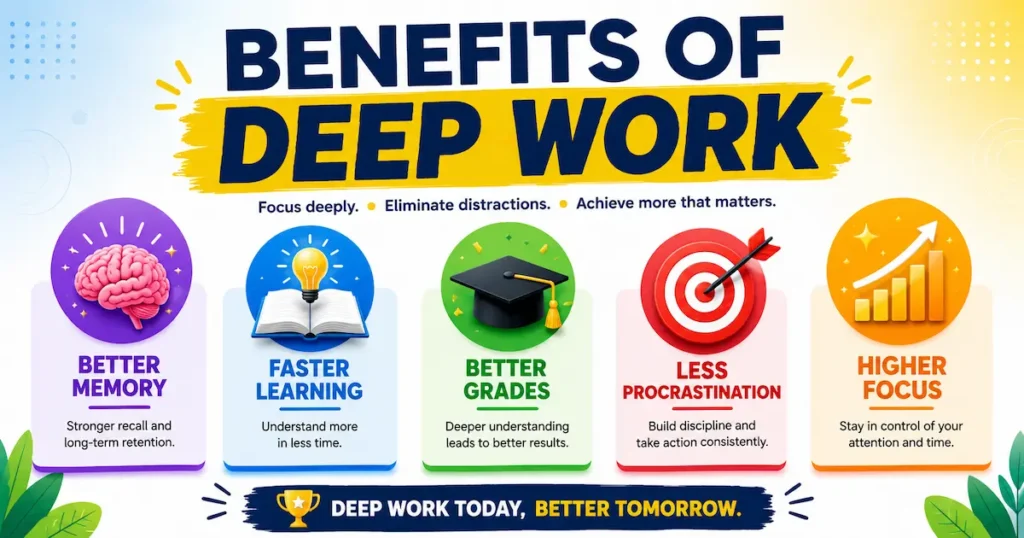
When you study with your mind, your brain can absorb any information very quickly and effectively. As a result, you do not need to revise the same reading repeatedly, any difficult idea easily enters your mind.
2. Memory power is strengthened
The deep work method for students basically helps in creating long-term memory. In this, the reading is embedded in the mind without being easily forgotten, which makes your exam preparation much easier.
3. Great success in studies
Students who study regularly following this method can complete their assignments and tasks in a very short time. As a result, the quality of their work improves a lot.
4. Laziness and procrastination are reduced
When you start working with full attention, you develop a kind of love for studying, which removes laziness and inspires you to finish the work quickly.
When you set aside specific times to study carefully, you are less likely to procrastinate on important tasks.
How to start the deep concentration method for students
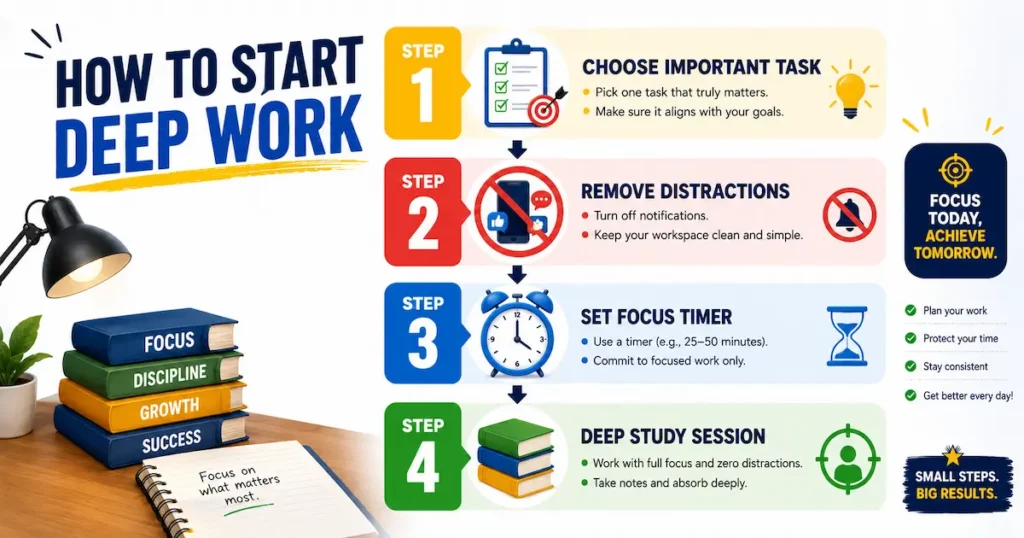
Step 1: Choose an important task
Choose the most laborious task of the day.
Some practical examples:
- Solving complex mathematical problems in physics
- Writing a research or analytical essay
- Final and thorough preparation for an exam
- Intensive practice in coding or programming
- Avoid changing reading topics or tasks frequently
Step 2: Completely say goodbye to distractions
Do these things right before you start studying:
- Silent all notifications on your phone
- Keep your phone out of sight or away
- Close unnecessary tabs on your laptop or computer
- Tell others in your family not to disturb you during this time
Even the slightest distraction is enough to destroy your full concentration.
Set a specific time or routine for deep reading
Start the habit with a small amount of time without setting a very big target at the beginning.
A suggested chart to gradually increase your focus:
| Week | Focus Time |
| Week 1 | 30 Minutes |
| Week 2 | 45 Minutes |
| Week 3 | 60 Minutes |
| Week 4+ | 90 Minutes |
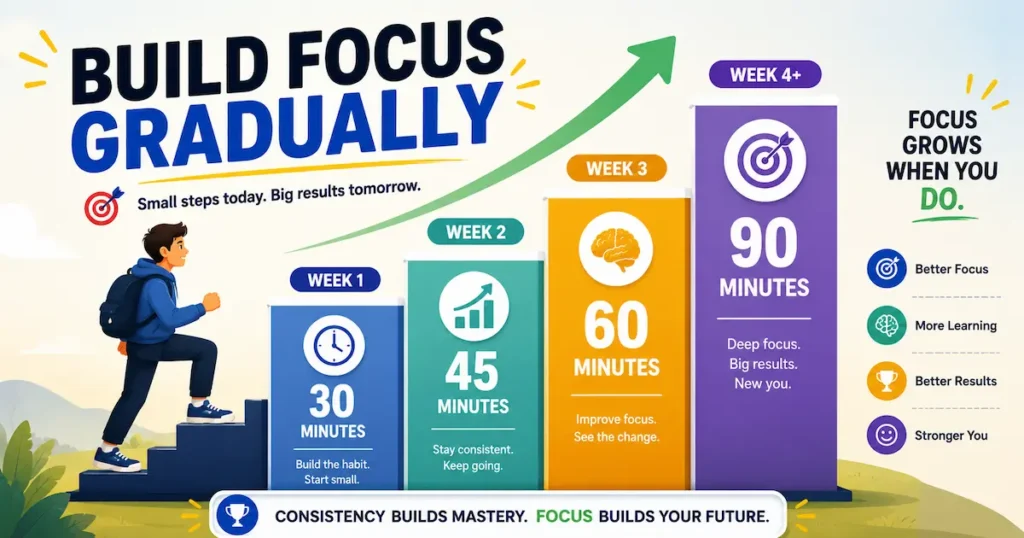
Continue to increase your focus gradually.
Deep Study Method for Students During Exams
Exam time is the best opportunity for students to practice the deep study method or this special technique.
The most effective routine for deep study for exams:
- First, look at your study goal for today
- Choose a specific topic to study
- Study with full concentration for 90 minutes continuously
- Take a short break of 15 minutes at the end of the session
- Then start the next session again
Studying according to this rule gives much better results than facing continuous noise and interruptions throughout the day.
Special strategies for students using AI tools
AI tools can help you a lot in studying. However, if you become overly dependent on them, your ability to think or analyze can decrease.
How to use AI wisely:
- For easy explanations of any difficult topic
- To create new questions for practice or practice
- To create a well-organized study plan or syllabus
- To clarify any confusing ideas or concepts
In cases where you should stay away from using AI:
- Getting all your assignments or homework done exactly by AI
- Using AI as a substitute for your independent thinking or intelligence
- Looking for shortcuts instead of trying to solve problems yourself
Your main goal is to learn the subject well, not to find any tricks or shortcuts.
Create a beautiful environment for deep and focused study
The depth of your attention depends a lot on the environment around you.
An ideal environment for studying:
- A neat and clean study table
- A comfortable chair to sit on
- Adequate lighting and ventilation in the room
- Keep the surroundings as noise-free as possible
- Have all the necessary study materials at hand in advance
Some helpful tools or devices:
- Use a website blocker app to avoid distractions
- Focus timer (Pomodoro) to measure time
- Noise-cancelling headphones to avoid outside noise
- A study planner diary to organize your studies
Some common mistakes students make while studying deeply
Trying to concentrate for a long time continuously:
Those who are completely new often make the mistake of trying to stay immersed in their study table for 3 to 4 hours at a time in the beginning. The rule is to start with a short time and gradually increase that time.
Multitasking
Doing multiple things at once reduces your productivity. Focus on one thing at a time.
Seeing Notifications
Every interruption slows down your work.
Putting your devices away when you are deep in your work.
Neglecting Sleep
Working deeply depends on brain function. Insufficient sleep significantly reduces your focus.
Deep Work vs. Pomodoro Technique
Many students want to know which method is better.

| Deep Work | Pomodoro |
| Longer focus periods | Short work intervals |
| Best for complex learning | Good for getting started |
| Builds concentration stamina | Prevents fatigue |
| Ideal for difficult subjects | Ideal for routine tasks |
A combination of these often works best.
Use Pomodoro to increase focus, then go for a longer deep work session.
A simple daily deep work routine
Morning
- Planning priorities
- Completing a deep work session
Afternoon
- Doing class or coursework
- Reviewing notes
Evening
- Deep review sessions
- Practice active thinking
Consistency is more important than perfection.
Signs that your deep work skills are improving
Things you may notice:
- Longer attention span
- Faster learning
- Better grades
- Reduced procrastination
- Reduced reliance on your phone
- More confidence while studying
These improvements usually develop gradually.
Frequently Asked Questions (FAQ)
Question: What is the Deep Work Method for Students?
The Deep Work Method for Students is a modern and scientific study technique. It basically helps to immerse oneself deeply in any difficult and complex academic subject by keeping all kinds of distractions away from the surroundings.
Question: How long should a student practice Deep Work?
Those who are completely new can start practicing it with 30 to 45 minutes a day at first. Later, as the ability to concentrate increases, it is possible to do this Deep Work continuously for 60 to 90 minutes or more like experienced students.
Question: Is the Deep Work Method better than multitasking?
Yes, it is definitely better. Multitasking reduces your performance and attention. On the other hand, the Deep Work Method increases the quality of your studies, ability to remember information, and productivity many times over.
Question: Does this method come in handy during exams?
Absolutely true. If you follow this technique right before the exam, any difficult reading you have will be memorized very quickly, it will be embedded in your memory for a long time and the time spent on reading will be 100% useful.
Question: Is it possible to do deep work in online classes too?
Yes, it is very effective for online learning. This method helps a lot in maintaining the attention on the screen while studying various online courses, virtual lectures or by yourself.
Question: Can I use the Pomodoro technique with deep work?
Of course you can. Many students can use 25 or 50 minute Pomodoro sessions as an initial step to develop a habit of continuous reading for a long time, and can use it to build your focus.
Conclusion:
In today’s era of social media and notifications, studying with intense attention is one of the best academic skills for you. Students who learn to control their attention easily understand difficult topics quickly and are free from the additional mental stress of studying.
Remember, you don’t have to be perfect from day one. Start your journey today with any of the distraction-free short sessions. Be confident in yourself, maintain consistency, and gradually develop this great habit within yourself.
Tell us about your experience!
Have you ever tried applying the “Deep Work Method for Students” in your studies? What is your study routine like, what are the problems you have with focusing, or if you know any secret tips to increase productivity, you can share them with us by commenting below. Your small experience can help improve the quality of studies of many other students!