

Introduction:
Learning how to study multiple subjects in a day is an essential skill for every student. Whether you’re cramming for exams, tackling daily school assignments, or juggling multiple courses—the right strategies will help you stay focused for longer without tiring your brain.
In this guide, we’ll learn how to organize your reading material, avoid getting confused or overwhelmed by difficult topics, improve your memory, and create a great study plan that will keep you productive throughout the day.
Why Learning to Study Multiple Subjects Is Important
Most students typically have to study multiple subjects in the same day, such as math, science, language arts, and social studies.
However, if the correct and scientific strategy is not known, the following problems often arise:
- Severe mental fatigue
- Overabundance of information
- Extreme lack of attention while studying
- Decreased ability to remember or retain what has been read
- Increased mental stress and anxiety
Various studies on cognitive psychology show that when new information is properly organized in the brain and study sessions are organized in an effective way, our brain absorbs any subject better.
Understanding how the brain handles multiple subjects
When you suddenly switch from one subject to another while reading, your brain goes through a complex process called context switching.
Frequently changing subjects like this without any prior planning can create a kind of confusion in the mind and memory can also decrease due to not being able to remember what has been read easily.
However, changing the subject of reading in a well-planned way can improve the following areas:
- Long-term memory
- Attention and deep concentration
- Immediate ability to solve any problem
- Overall effectiveness of studying or learning
The best way to read multiple subjects in a day
1. Create a daily subject plan before starting
Never start reading without specifying exactly what you will read today.
Instead of telling your subconscious mind vague things like:
- I will read science today.
Always use specific goals or targets:
- I will finish the notes on photosynthesis today and solve 10 difficult questions in biology.
A clear and precise plan reduces your decision-making fatigue and keeps you focused on the main subject of reading.
Example of a study plan
| Time | Subject | Task |
| 8:00 AM – 9:00 AM | Mathematics | Algebra Practice |
| 9:15 AM – 10:15 AM | English | Reading and Summarizing |
| 10:30 AM – 11:30 AM | Science | Chapter Review |
| 2:00 PM – 3:00 PM | History | Timeline Review |

2. Studying different types of subjects in sequence
One of the biggest mistakes students make while studying is studying the same category or type of subject in a row.
Wrong method of subject sequencing
- History
- Geography
- Literature
Remember, all three subjects require a lot of reading and memorization.
Correct method of subject sequencing
- History
- Mathematics
- English
- Chemistry
This scientific method of studying reduces stress or boredom by using different parts of your brain.
Why it works
When you change subjects, your brain basically processes information in the following way:
- Mathematics → Logical thinking
- Science → Analytical reasoning
- History → Memory recall
- Language → Verbal or linguistic processing
If you alternate or work between these in your reading routine, your mind will always be completely fresh.

3. Use time blocking instead of continuous study
If you study for several hours straight without taking any breaks in between, your attention span will start to drop rapidly. So time blocking is a very effective method.
Popular Study Block Methods
Method 1: Pomodoro Technique
- 25 minutes of full attention
- Take a short break of 5 minutes
- Repeat the whole process four times in a row.
Method 2: Deep Focus Method
- 50 minutes of deep attention
- Take a relaxing break of 10 minutes
Students who do very well in exams usually prefer this deep focus method for difficult and complex subjects.

4. Set a goal for each study session
Each of your study sessions or study blocks should have a specific and visible outcome.
Some great examples:
- Solving 20 math problems
- Memorizing at least 15 important terms in biology
- Completing an outline for a specific essay or composition
- Quickly reviewing or revising any major chapter
When the reading goal is so specific, the quality and output of the study becomes more productive.
How to study without getting confused with multiple subjects
Using separate notes for each subject
Maintaining a completely separate notebook for each subject on your study table or a separate digital folder on your computer. This creates a clear boundary for your reading in your mind.
To make it easier, you can also use:
- Different colored notebooks or covers
- Create separate folders based on the subject
- Keep a separate set of flashcards for each subject
Review for three minutes before changing the subject
Just before you finish reading and move on to a new subject, do this:
- Gently close your reading book.
- Try to recall the main points you just read from your memory.
- Summarize the entire lesson in just one sentence.
Example
For example, after finishing reading biology, think to yourself:
- Photosynthesis is basically a process of converting sunlight into chemical energy through chlorophyll.
That’s it, now you can safely move on to your next new topic.
Going directly from one topic to another can cause mental fatigue.
So instead of diving from one reading table to another, in the meantime:
- Take a walk inside the house for at least 2-5 minutes
- Drink a glass of cold water
- Do some light exercise or stretching
- Take your eyes off the laptop or phone screen
This short break will refresh your brain and make your attention completely alert and fresh for the next topic.
Best subject combination strategy
Some subjects work better together than others when it comes to studying.
Effective subject pairings
Math + History
This combination basically strikes a nice balance between the brain’s reasoning and memory for information.
Chemistry + English
This creates a great combination of your analytical reasoning and linguistic or verbal skills.
Physics + Literature
Provides a nice change or balance between complex mathematical calculations and simple reading.
Biology + Economics
Doesn’t put extra strain on the brain by using two completely different cognitive processes.
Subject Pairs to Avoid
Try not to study these subjects together for long periods of time to avoid mental fatigue:
- History + Literature (both require a lot of reading)
- Geography + History
- Biology + Reading Biology revision notes for hours
- Reading subjects like writing multiple essays or compositions in a row
Such heavy combinations can greatly increase your mental fatigue or boredom. So it would be wise to avoid these combinations when deciding how to study multiple subjects.
How many subjects should you study in a day?
The ideal number depends on your personal goals and daily schedule.
School students
- 2-4 subjects per day
Board exam students
- 3-5 subjects per day
University students
- 2-4 main subjects
Here, maintaining the quality of reading is much more important than quantity.
How to study multiple subjects during exam preparation
Study during exam season requires a slightly different and strategic approach.
Priority-based study method
Categorize the subjects to be studied into three main categories at the beginning.
High priority
- Upcoming exams or subjects that are very close
- Your weak subjects
Medium priority
- Subjects in which you have medium confidence or preparation
Low priority
- Subjects that you already understand or know very well
Always allocate more time to the subjects on the high-priority list.
Follow the 60-30-10 rule
Many successful and topper students in exams use this particular method:
- Devote 60% of the total time to your weak subjects
- Spend 30% of the time on average subjects
- Devote only 10% of the time to already strong or easy subjects
This rule will help you improve your overall academic performance very quickly.
Digital tools that help you study multiple subjects
Modern technology can make the entire management or system of your studies much easier.
Best study apps
Notion
For planning your study subjects and tracking daily tasks.
Google Calendar
For scheduling specific study sessions or routines in advance.
Quizlet
For creating digital flashcards and practicing memory.
Anki
For scientific spaced repetition learning or spaced repetition.
Forest
To reduce distraction or distraction due to phones while studying.

Common mistakes made by students
1. Reading the same type of material at the same time
Reading similar materials in succession disrupts attention and increases the confusion of reading.
2. Multitasking
Watching videos or chatting in the background while studying is rarely effective. Therefore, give full attention to only one task at a time.
3. Ignoring breaks
The brain needs some relaxation or recovery time to permanently store what has been read in the head.
4. Using only passive reading
The following methods are much more effective in remembering what has been read than reading the pages of a book repeatedly:
- Recalling reading actively
- Solving various practice questions
- Taking regular self-tests or mock tests
5. Not following a study schedule
Without a plan, students often spend too much time on their favorite subjects and avoid difficult subjects.
Modern study methods that students are using in 2026
Recent educational research and student performance data show the increasing use of the following modern techniques:
Active recall
Taking self-tests or quizzes instead of reading notes repeatedly.
Spaced repetition
Revisiting or revising previously studied information at regular and increasing intervals.
Intermixing
Arranged reading time and practicing different topics and different question types together.
AI-powered learning tools
Today’s students are now using various AI study assistants in their studies:
- For easy summaries of large chapters
- For new practice questions
- For precise revision plans
- For easy explanations of any difficult concepts
However, these tools can significantly improve your study effectiveness only when combined with active and practical learning.
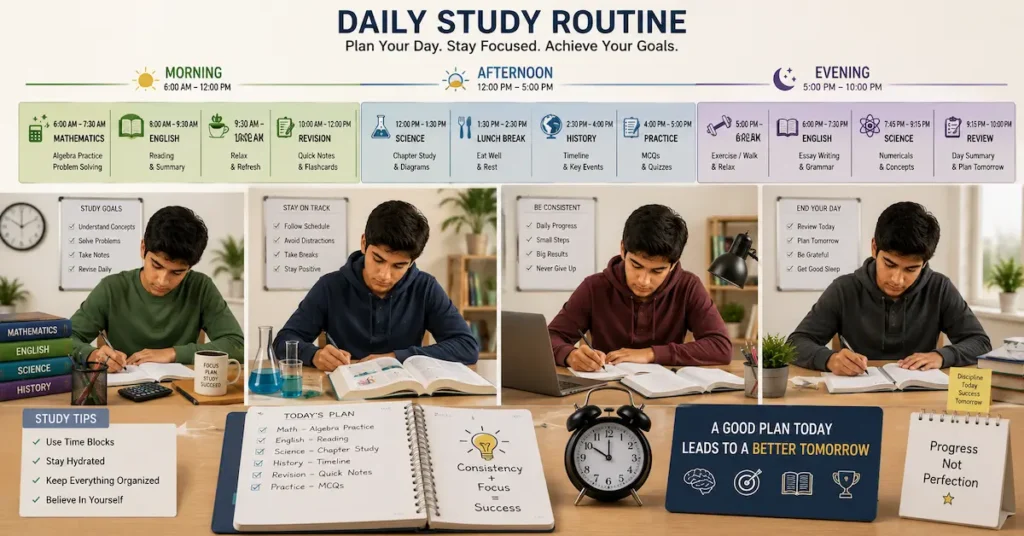
Sample Daily Schedule for Studying Multiple Subjects
Morning
8:00 AM – 9:00 AM ➔ Math
9:15 AM – 10:15 AM ➔ English
Afternoon
1:00 PM – 2:00 PM ➔ Science
2:15 PM – 3:15 PM ➔ History
Evening
6:00 PM – 7:00 PM Entertainment
This sample schedule is designed to help you maintain a good balance between the different mental demands of the day.
Frequently Asked Questions
Question: How to study multiple subjects without getting tired?
Choose a variety of subjects to study, take regular short breaks, drink plenty of water, and avoid studying the same category of subjects in a row altogether.
Question: How many subjects should I study in a day?
Depending on the daily workload and the type of exam preparation, most students get the best and most effective results by studying 2 to 4 subjects per day.
Question: Is it better to study one subject or multiple subjects?
In long-term learning, knowing how to strategically study multiple subjects is more effective. This is because it increases your ability to remember information and eliminates boredom.
Question: What is the best order to study subjects?
When you have the most energy throughout the day, start with the most difficult subject, then alternate between logical and reading-based subjects.
Question: Can I study three or four subjects in a day?
Yes, of course. Many successful students easily study three or four subjects per day using well-planned time blocks and specific goals.
Question: What study method works best for multiple subjects?
A proper combination of active recall, spaced repetition, interconnection, and effective time blocking in studying always yields the best results.
Question: How long should I study each subject?
Most students usually benefit the most from a focused study session of 45 to 90 minutes followed by a short break of 5-10 minutes.
Conclusion:
Being proficient at studying multiple subjects doesn’t mean you have to spend the whole day hunched over the pages of a book. It really means organizing your valuable time well, choosing the right subject sequence, and using study strategies that are compatible with the way your brain learns.
Start today with a very simple daily schedule, study between different subjects, actively review your reading, and take calculated, purposeful breaks. A small improvement in your current study method can make a huge positive difference in your test results.
Do you have any of your own strategies for studying multiple subjects in a day?
Share your wonderful experience with us in the comment box below. Your valuable suggestions can go a long way in helping other students develop better study habits and achieve better test results.