
Introduction:
The debate over which is better, digital versus handwritten notes, is now quite heated in the world of education. Today’s students are studying with the help of online courses, video lectures, and various internet resources in addition to the classroom.
Both these means of note-taking have their advantages as well as some disadvantages. For example, a comparative study of digital versus handwritten notes shows that writing down notes in a notebook or pen makes it easier to remember and remember. On the other hand, typing on a computer or tab allows you to work very quickly, is easy to organize, and can be found anytime, anywhere.
For many students, the best solution is not to choose one over the other. A mixed method often provides you with the strongest learning outcomes.
Why taking notes is still important in 2026
Many students today think that taking notes is no longer necessary with the abundance of lecture slides, recordings, or AI tools.
However, this idea can have a very negative impact on your studies.

Regular note-taking can benefit you in many ways:
- The main points of the study are easily absorbed
- There is no opportunity to be distracted during class
- All the study information is organized
- Preparation can be done without stress before the exam
- The tendency to forget things studied is reduced
- The entire syllabus can be reviewed very quickly
The exact method you choose in studying determines the speed of your learning.
What are digital notes?
In simple terms, notes that are taken using various electronic devices are digital notes.
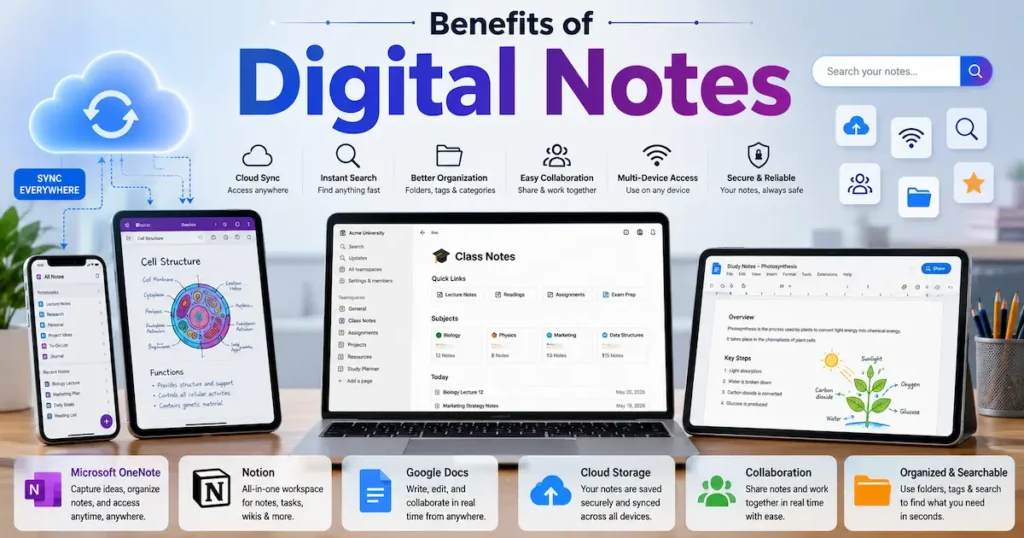
For example:
- Laptop
- Tablet or iPad
- Smartphone
- Digital notebook
Some of the most widely used note-taking platforms are:
- Microsoft OneNote
- Notion
- Google Docs
- Apple Notes
- Obsidian
- Evernote
Digital notes allow students to quickly jot down, organize, revise, and find information.
What are handwritten notes?
Handwritten notes are basically notes that are made using the traditional method of writing on paper with a pen:

- Using a notebook and pen
- Stitching in a diary
- On a separate sheet of paper
- Writing in the margins of a printed sheet
Students have been using this old method for many years because it directly engages the brain with reading.
Digital vs. Handwritten Notes: Quick Comparison
| Feature | Digital Notes | Handwritten Notes |
| Speed | Faster | Slower |
| Organization | Excellent | Moderate |
| Searchability | Instant | Difficult |
| Memory Retention | Good | Often Better |
| Sharing | Easy | Limited |
| Multimedia Support | Excellent | Limited |
| Distraction Risk | Higher | Lower |
| Battery Required | Yes | No |
| Portability | Very High | Moderate |
| Collaboration | Excellent | Limited |
Advantages of Digital Notes
1. Improved Organization
One of the biggest advantages of digital notes is their excellent organization functionality.
Here are some things students can easily do:
- Create separate folders as needed
- Identify different topics with tags
- Arrange in subject-based categories
- Search by typing any word
Bring information to your eyes in an instant without wasting time.
Example:
For example, you have a biology exam ahead.
Instead of wasting time searching for multiple notebooks, you can simply type “cell division” and get all the notes for that subject at once.
2. Easy editing
It is very normal to make mistakes in writing.
Digital notes give students the opportunity to:
- Correct mistakes instantly
- Rearrange paragraphs or lines
- Insert new information later
- Easily update reading materials
No need to cut out entire pages and rewrite them.
3. Multimedia education
The current education system is not limited to writing in books.
Digital notes can be easily added to:
- Necessary images
- Instructional videos
- Voice clips or recordings
- Important diagrams
- Website links
- PDF files
This makes your entire study much more interesting and effective.
4. Cloud access
Most digital note apps are synced across all devices via the internet.
As a result, you can access notes from anywhere:
- Your home
- School or college
- Library
- Any coffee shop
This feature fits in well with the modern-day learning environment.
5. Improved collaboration
Group projects or teamwork are now very common in schools and colleges.
How digital notes help you:
- Quickly share files with friends
- Work together at the same time
- Create a project together
- Make necessary comments on notes
It makes teamwork and communication much easier.
Benefits of handwritten notes
1. Strong memory
Various studies have proven that the habit of writing by hand keeps our brain functioning.
When students write by hand, they usually:
- Synthesize long lectures in their own way
- Think about ideas in their minds
- Write each line very carefully
This works great for reading quickly and remembering.
2. Improved attention
There is no shortage of distractions on the screen of digital devices.
For example:
- App notifications
- Social media chats
- Messages or inboxes
- Online games
- A pile of browser tabs
A simple notebook eliminates all these dangers. Because of writing on paper, you can study for a long time with one mind.
3. Improved conceptual learning
Handwritten notes are most effective in subjects that require logical or visual thinking.
For example:
- Mathematics
- Physics
- Chemistry
- Engineering
It is much easier to match equations, create graphs, draw arrows, or draw pictures on a notebook page.
4. No technical issues
When taking notes with a notebook or pen, you never have to worry about:
Charging the device
- Internet or WiFi connection
- Software updates or crashes
- Cloud storage running out
A simple notebook works reliably anytime and anywhere.
The science behind memory and learning
Many people have wondered:
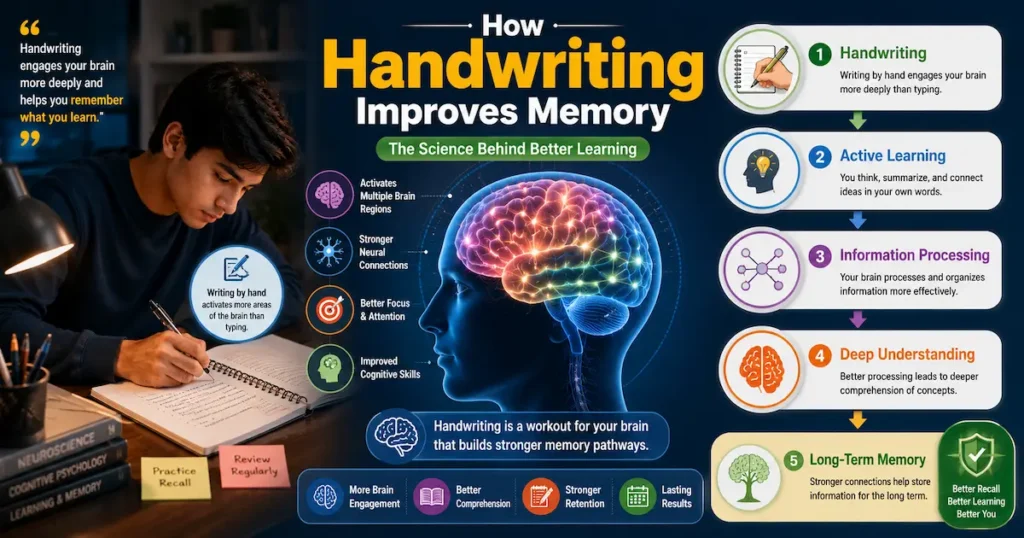
Do handwritten notes really help improve our memory?
The answer is often yes.
When typing, students can copy information exactly without thinking deeply.
When writing by hand, students usually summarize information in their own words.
This process strengthens your ability to learn.
Why is this so?
Handwriting encourages:
- Active learning
- Information processing
- Improved attention
- Deep comprehension
However, memory improvement depends on how the notes are taken. Mindlessly writing by hand is not automatically better than thoughtfully taking digital notes.
Digital vs. Handwritten Notes for Different Subjects
It is not really right to implement the same method for studying all types of subjects.
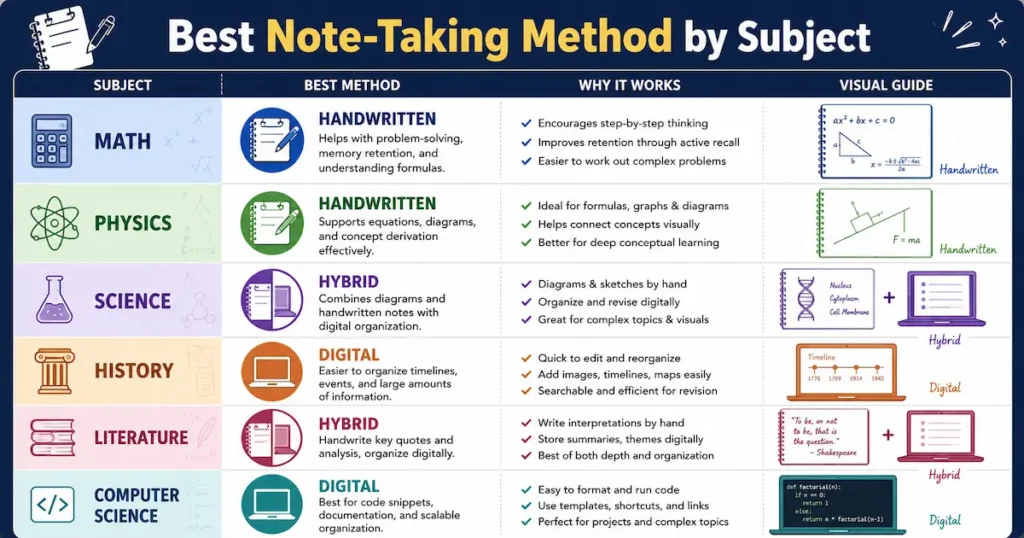
Mathematics
Best choice: Handwritten
Because:
- Complex equations can be written easily
- Quick diagrams can be created
- Equation of equations by hand feels much more natural
Science
Best choice: Hybrid (mixed method)
Because:
- It is better to write down formulas by hand
- Digital storage is needed to keep diagrams and research files
History
Best choice: Digital
Because:
- A large collection of theories and information can be quickly organized
- Easily searchable
Literature
Best choice: Hybrid
Because:
- Key notes for reading can be kept digitally
- In-depth analysis and explanations of content are better written by hand
Computer science
Best choice: Digital
Because:
- Copy-paste code snippets
- Saving technical documentation
- Easily updateable at any time
Digital vs. handwritten notes in online education
Online education is the whole of students’ learning It has changed the way many students study these days:
- With the help of video classes
- Through various courses on the internet
- Inside virtual classrooms
- From various educational apps or platforms
Notes in digital format usually adapt very well to this environment.
Its main advantages are:
- Saving necessary screenshots
- Adding links to useful websites
- Organizing all the class materials
- Recording live class lectures
For those who take classes online, the habit of creating digital notes can save a lot of time.
AI and modern note-taking methods
Artificial intelligence is changing the current world of education a lot.
Many of today’s note-taking applications have added:
- Self-generated short summaries
- Directly written by listening to your voice
- Modern or smart search options
- Draft outlines created by AI
These modern features help you organize information with much less effort.
However, you should not rely entirely on this artificial intelligence. Real learning comes from your own thinking, processing and understanding of information—you cannot learn by just storing data or information in one place.
Common mistakes made by students
Writing everything down
Writing down every word of the speech exactly reduces the real value of your study. Things to pay more attention to:
- Main content or theme
- Original ideas
- Some useful examples
Never revise notes
Written information is only effective when you revise it regularly. So create a routine or schedule for studying. For example:
- Blink after 1 day
- Review after 1 week
- Revise after 1 month
Using multiple methods at once
Some students are seen to change apps frequently or confuse notebooks and devices.
Choose any one main medium and stick to it. Discipline will greatly increase your work efficiency.
Ignoring active recall
Reciting notes over and over again is not enough.
Instead:
- Cover up answers
- Test yourself
- Use flashcards
- Explain concepts out loud
Active recall strengthens memory.
Hybrid note-taking methods
Many successful students combine both methods.
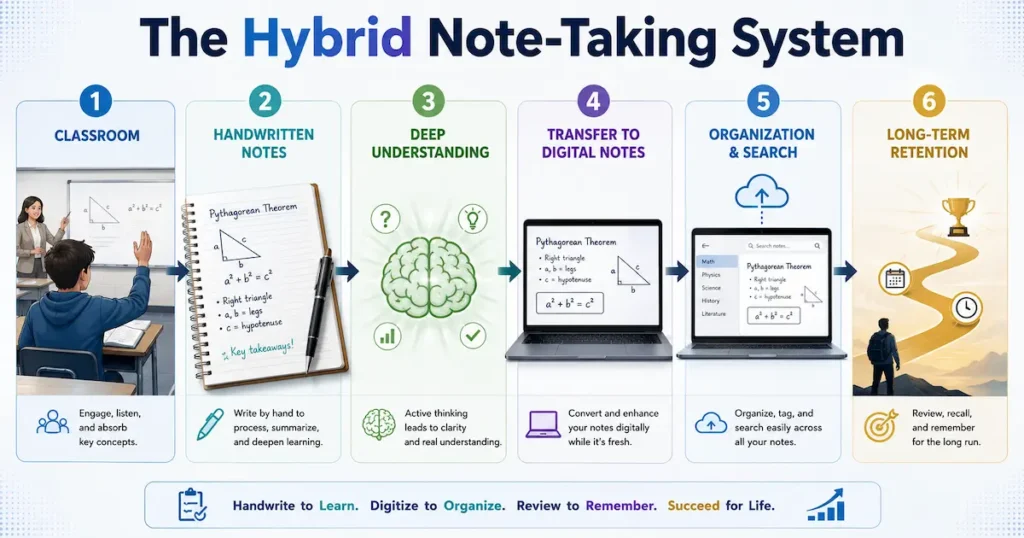
A simple method looks like this:
Use handwritten notes during class.
Benefits:
- Improved focus
- Deeper comprehension
- Less distractions
Transfer important information digitally after class.
Benefits:
- Improved organization
- Easy search
- Long-term retention
- This method combines the benefits of both methods.
How to choose the best note-taking method
Ask yourself these questions:
Are you easily distracted?
Choose handwritten notes.
Do you need quick organization?
Choose digital notes.
Do you study for topics that are highly visible?
Choose handwritten notes.
Do you often work on group projects?
Choose digital notes.
Do you want the best of both worlds?
Choose a hybrid system.
Some of the best note-taking tips for students
Whatever your method:
- Focus on understanding, not copying
- Use headings and subheadings
- Identify important points
- Review notes regularly
- Use active recall techniques
- Keep notes organized
- Avoid multitasking while reading
Small improvements in note-taking can lead to significant improvements in learning.
Frequently Asked Questions
Question: Are digital notes better than handwritten notes?
No method is universally best. Digital methods are superior in terms of organizing information and providing various benefits, and writing on a notebook or pen usually improves your memory and attention span.
Question: Do handwritten notes improve memory?
Several studies have shown that writing by hand embeds any information deeply in your brain, which helps you understand and remember what you read.
Question: Are digital notes good for college students?
Yes, of course. College students usually have to deal with a very large syllabus and a lot of information, so the digital format and search facilities are very useful.
Question: Can I use a tablet to take handwritten notes?
Yes, you can. Tablets with a stylus or touch pen combine the feel of writing on paper with all the modern conveniences of digital storage.
Question: Which method of taking notes is best for exams?
A mixed or hybrid method of both media works best. Handwriting helps you understand what you are reading, and digital formats make it easier to revise.
Question: Should students switch to digital notes entirely?
Absolutely not. The best medium really depends on your reading style, depth of subject matter, and personal preference.
Conclusion:
There is no clear winner in this battle between digital and handwritten notes. Digital means ensuring your speed, discipline, collaboration, and accessibility of information.
On the other hand, using a notebook and pen helps you focus, comprehend, and study for longer.
Rather than thinking about which method is more modern, think about which method is helping you master your studies better.
Many high-achieving students have found that a proper combination of the two mediums creates a strong study habit that greatly enhances their intelligence and academic performance.
Share your experience
How do you prefer to take notes—on a digital device, with a familiar notebook and pen, or a combination of both?
Let us know your favorite method and any useful tips by commenting below. Your comment can help other students choose the right path!